
Walk down any street in Jamnagar and you’ll see the entire brass supply chain laid out in front of you. Scrap dealers. Casting plants. Extrusion lines. Turning shops. Platers. All within a few hundred metres of each other.
This city doesn’t just make brass components — it breathes them. Brass is the livelihood of an entire region, and with copper prices climbing the way they have been, every kilogram of it carries serious money.
But here’s what nobody in that ecosystem is going to volunteer: brass grade differences are completely invisible to the naked eye. Two rods sitting side by side can look identical. Same colour. Same finish. Same weight. Completely different alloy.
The basics of brass — copper and zinc, lead for machinability, different grades for different applications — that’s all on the internet. AI can give you that in three seconds. What isn’t on the internet is how brass grade differences get quietly weaponised between the RFQ and the shipment. That’s what this post is about.
1. “Free Cutting” Is a Lie — Brass Grade Differences Start With the Country You’re Standing In
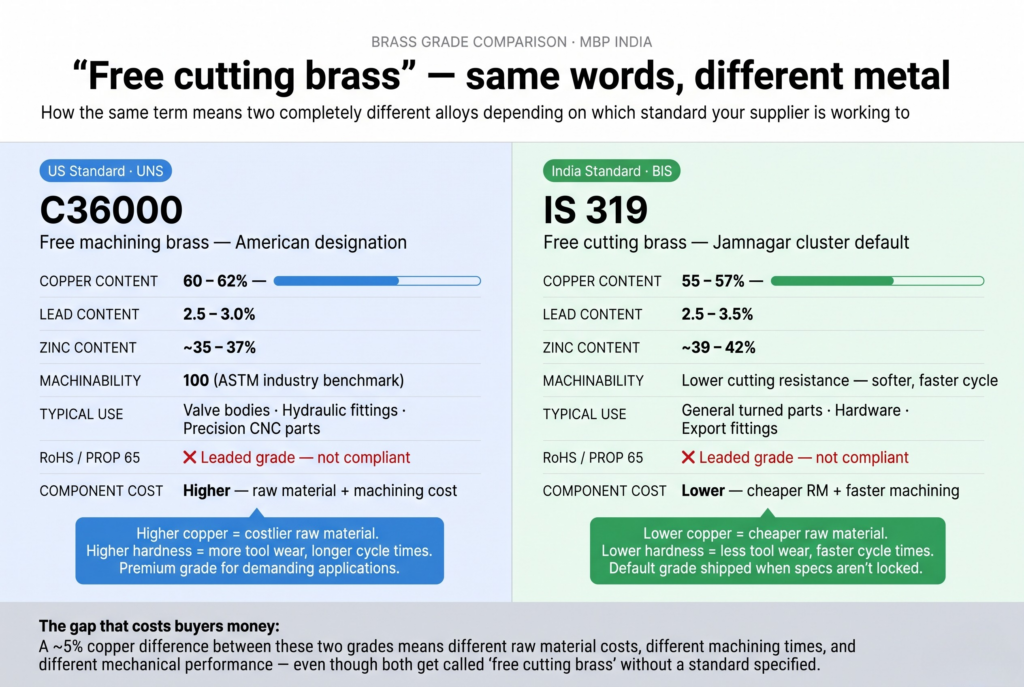
Ask a supplier in Jamnagar for free cutting brass and you’ll get a rod with around 56% copper and 3% lead. That’s the grade that runs through this city like water. It’s the default. The baseline. The grade behind the mass of components coming out of this cluster.
Ask a buyer in the US what free cutting brass means and you’re in completely different territory. C36000. 60 to 62% copper. 2.5% lead. Harder to machine. Significantly more expensive raw material. The brass grade differences between IS free cutting and UNS C36000 alone can affect strength, pressure resistance, and long-term component performance.
Same words. Completely different metal. And nobody flags it.
When a drawing says ‘free cutting brass’ without specifying IS, UNS, or CW standard, that gap is an open invitation. A supplier under margin pressure will walk straight through it. You’ll get parts quoted at C36000 prices but made from 56% copper stock — or worse, the reverse.
The fix: Never write ‘free cutting brass’ on a drawing without the standard. Specify the grade. Specify the standard. Every single time.
2. Leave Your Grade Blank and Someone Will Fill It In For You
Old drawings are a supplier’s best friend. Legacy components that have been in production for years often carry vague or missing material specifications. ‘Brass’ is not a grade. ‘Yellow metal’ is not a grade. Even ’60/40 brass’ is ambiguous enough to exploit. These are the brass grade differences that never show up in a dispute because there was never a clear spec to dispute.
When price pressure is high and the drawing doesn’t lock the grade, the path of least resistance is obvious. Drop to the cheapest available stock that technically fits the description. In Jamnagar, that’s often the 54–55% copper hardware grade — the one meant for door hinges and latches, not precision machined components.
Below that copper content, it’s not really brass anymore. But by the time that shows up in your product performance, you’re already three shipments deep.
The fix: Audit every legacy drawing before reissuing an RFQ. If the material field isn’t locked to a specific grade and standard, it’s a liability — not a specification.
3. Your MTR Is Only As Honest As the Guy Who Staged It
Most overseas buyers don’t have spectrometers. So they ask for Material Test Reports with every shipment. Reasonable. Standard. Completely gameable.
Here’s how it gets played: one piece of the correct grade gets tested. That certificate gets attached to every shipment going forward. The actual production material is something else. The MTR is real. The material it represents is not in your box. This is one of the most common brass grade differences that never gets caught — because the paperwork looks perfect.
You won’t catch it on arrival. You’ll catch it when parts fail. When a pressure test comes back rejected. When a corrosion issue appears on a grade that shouldn’t corrode in that environment. By then, the shipment is installed and you’re absorbing the cost.
The fix: Request heat-number-specific MTRs tied to the actual production batch. Better still, third-party spectrometer verification at the supplier’s facility before goods leave.
4. Hitting the Target Number Doesn’t Mean You Got the Right Metal
Cost pressure pushes some suppliers toward low-grade scrap as raw material input. The logic works on paper — blend the right scrap mix, hit the copper and lead percentages of the target grade, pass the spectrometer check.
What the blend also carries are impurities. Iron. Tin. Aluminium. Elements that don’t register as a failed grade test but absolutely show up in mechanical performance. Brittleness. Inconsistent machinability. Premature fatigue under load or pressure.
The brass grade differences between virgin certified material and scrap-blended stock carrying the same grade label can be significant — even when both clear a basic composition check. Composition ratios don’t capture the distribution and behaviour of trace elements through the material. Your parts can pass incoming inspection and still fail in the field.
The fix: Specify maximum allowable impurity thresholds in your purchase order — not just the grade designation. Ask your supplier directly whether they use virgin or recycled raw material input.
5. Lead-Free Isn’t a Checkbox. It’s a Different Brass Entirely.
RoHS compliance and California Proposition 65 are not suggestions. For anything going into the EU or US market — especially products touching drinking water, food contact, or consumer applications — lead content is a hard legal limit. These are brass grade differences with legal consequences, not just technical ones.
But lead-free brass isn’t regular brass with the lead removed. It’s a fundamentally different alloy — bismuth brass, silicon brass, or certified low-lead grades — engineered to maintain machinability without lead. The EU RoHS Directive is explicit on this: substituting leaded brass and calling it compliant is not an option. It costs more. It machines differently. And the liability for non-compliance lands on your side of the transaction.
Some suppliers mark components RoHS compliant based on a self-declaration rather than third-party testing. Some ship leaded material when buyers don’t verify. Don’t find out the hard way.
The fix: Require third-party RoHS test certificates, not declarations. Specify the exact lead-free grade by designation — CW511L, C69300, or equivalent — on every order.
6. No Metallurgist on the Floor Means No Consistency in Your Box
Most of the Jamnagar brass cluster is made up of small, family-run operations — businesses passed down through generations, running on institutional knowledge rather than formal metallurgical process control. That knowledge is often deep and genuine. But it has real limits, and those limits show up as brass grade differences from one batch to the next.
Without metallurgical oversight, grade consistency becomes a function of habit rather than science. Casting temperatures vary. Extrusion conditions aren’t precisely controlled. And in brass, temperature inconsistency during pouring or extrusion can cause lead to separate from the alloy — pooling into micro-pockets rather than distributing evenly through the material.
This isn’t visible to the naked eye. It won’t get caught on a standard spectrometer check. It shows up when a machined component that looked perfect fails a pressure test — because there’s a structural weak point where the lead separated and left a void inside the metal.
This is not theoretical. It has happened with hydraulic components sourced from suppliers who were actively exporting to international markets without a single metallurgist in the building. The parts looked right. The MTRs looked right. The failure told a different story.
The fix: Qualify suppliers on process capability, not just price and lead time. Ask specifically about temperature control records, casting or extrusion process documentation, and in-house metallurgical oversight.
7. Your Eyes Are Useless Here. So Is Trust.
You cannot tell brass grade differences apart by looking at them. You cannot tell them apart by feel, by colour, or by finish. An IS 56% copper rod and a C36000 at 62% will look identical on your shelf, in your inspection area, and in your finished component. This is exactly why brass grade differences are so consistently exploited — there’s no visual signal that anything is wrong.
The only tool that gives you a definitive answer is a spectrometer. The only structural solution is sourcing from suppliers who control their input material — not just their output dimensions.
The Jamnagar brass industry is not monolithic. There are suppliers here who have invested in certified material sourcing, in-house spectrometer verification, documented process controls, and metallurgical oversight that starts at raw material intake — not at final inspection. Those suppliers cost more to work with.
They’re also the ones whose parts don’t fail.
The brass grade differences that cost buyers money aren’t always deliberate fraud. Sometimes it’s margin pressure. Sometimes it’s ignorance. Sometimes it’s a system that was never built to catch it. But the outcome for the buyer is the same regardless of the reason.
Know What You’re Ordering. Then Verify It.
Brass is not a commodity. It’s an alloy family with dozens of grades, multiple competing international standards, and a supply chain that has every structural incentive to default to the cheapest interpretation when buyers don’t specify clearly.
The seven brass grade differences in this post aren’t edge cases. They show up in rejected shipments, failed pressure tests, compliance violations, and components that quietly underperform for years before anyone traces it back to material.
At MBP India, we source certified material, run in-house spectrometer verification, and provide heat-specific MTRs with every shipment. If you’re sourcing brass components and want to actually get what your drawing specifies.